- London is Blue Dispatch
- Posts
- Analyzing BlueCo's Transfer Strategy
Analyzing BlueCo's Transfer Strategy
Has Chelsea's ownership truly ruined the club with its youth first policy? Or is it actually paying off eight transfer windows down the line?

Sam GR
January 30, 2026
In partnership with

Receive Honest News Today

Join over 4 million Americans who start their day with 1440 – your daily digest for unbiased, fact-centric news. From politics to sports, we cover it all by analyzing over 100 sources. Our concise, 5-minute read lands in your inbox each morning at no cost. Experience news without the noise; let 1440 help you make up your own mind. Sign up now and invite your friends and family to be part of the informed.
Halfway into the season, with the Club World Cup manager jettisoned into space like an intruder in Among Us and a central defence reeling due to the absence of the injured Levi Colwill, there is talk of buying more, after an expenditure inching towards €1.5 billion.
With the January window almost done and dusted, all eyes will now be on Chelsea’s moves in the summer. BlueCo’s strategy has proven highly divisive amongst the Chelsea faithful. Most are asking if the hierarchy remains hell-bent on sacrificing short term success in the name of long-term sustainability & planning. Eight windows into the Clearlake era, just how well has BlueCo’s plan worked out?
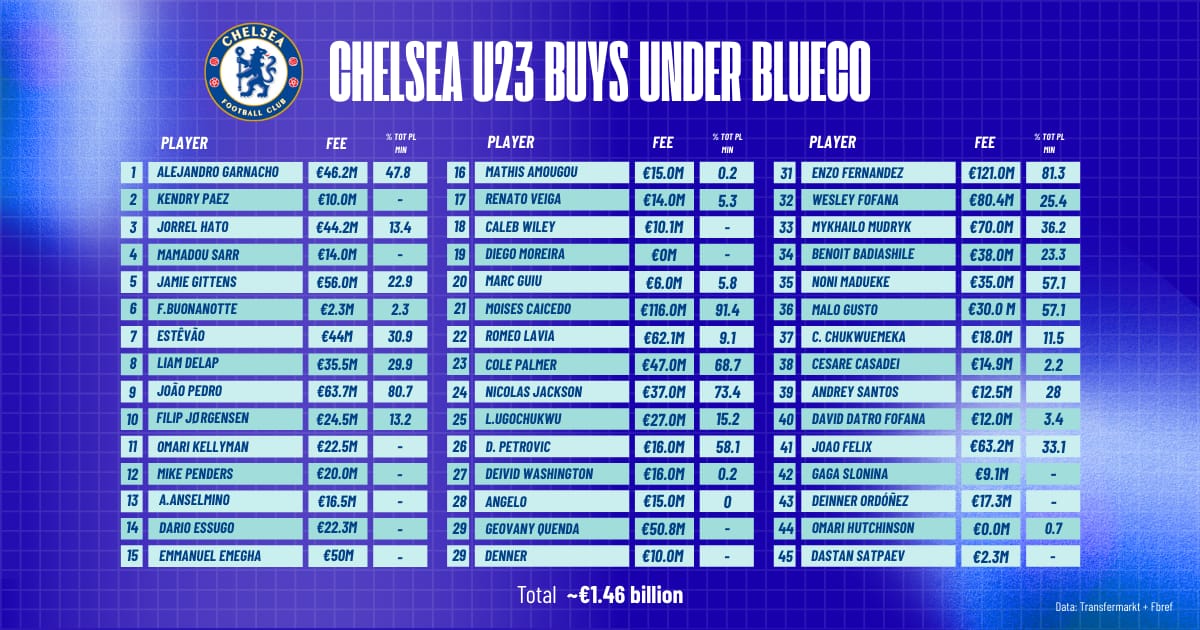
Let’s go over some of the key takeaways from this rather simple data set.
1) BlueCo have spent ~€1.46 billion on around 45 players aged 23 or under in the last seven windows. That’s an average of ~€32.4 million per signing.
2) 33% of these U23 signings, bought for an approximate €269 million, have not yet played or will not play a single minute for the Chelsea first team.
3) Only 9 of these 45 players have featured in 50% or more of the total PL minutes since they were signed for the club. 30 of these 45 players have played less than 20% of the total PL minutes they’ve been available for.
4) Romeo Lavia is yet to cross 1000 minutes in the PL in two-and-a-half-seasons at the club. He has played 9.1% of the total PL minutes available since he was signed, which equates to Chelsea paying €70,000 for each minute he has played in the PL.
Selling Power
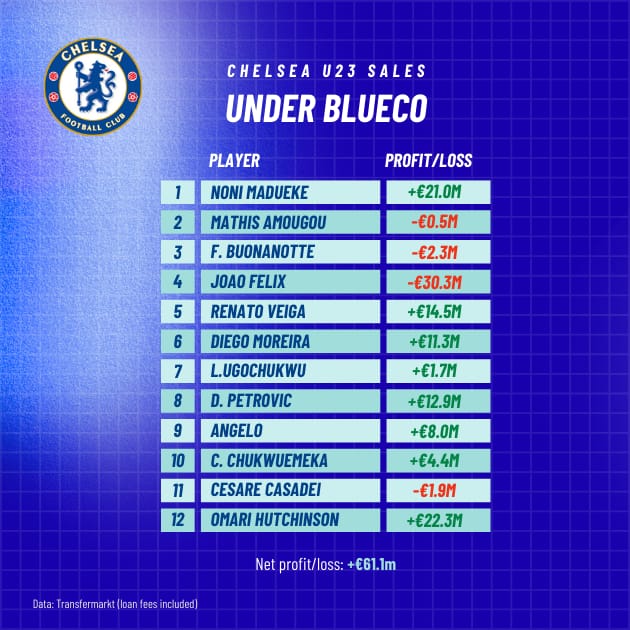
BlueCo, despite paying over market value for several players, has managed to make a tidy profit of €61.1m from from the sales of 11 players that they themselves bought. Joao Felix, like most predicted, was a baffling waste of money, but largely, the hit rate on a positive turnover is good. The upside of flipping someone like a Renato Veiga for €14.5m in the space of a year far outweighs the potential downside of having to sell the likes of Casadei or Amougou for a minor loss.
Caveat the above point of course with the fact that the next time this graph is updated, there will be bigger hits. The money spent on Mykhailo Mudryk now feels like it would have been equally effective if spent on NFTs. Deivid Washington arrived as €16.6m player, had his loan cut short by the same club they bought him from and is bleeding value in the reserves.
Joe Shields’ protegees (barring Cole Palmer), usually bought for vastly inflated sums from other clubs, will probably make a massive dent in these numbers with Jamie Gittens, Romeo Lavia & Liam Delap all struggling to live up to their price tags. With vastly better options appearing in the market, it wouldn’t be surprising to see a few more departures.
The Structure
Low risk/medium turnover/high reward (free - €35m)

Moises Caicedo and Kaoru Mitoma went from the Ecuadorian and Japanese leagues to the PL after taking less than a season to acclimatize in Europe (Caicedo & Mitoma both had loans in Belgium, Caicedo for half-a-season at Beerschot, Mitoma for one at USG.) Mitoma joined Brighton for between €2 & 3 million, Caicedo for €4 million. A season or so later their values had touched €75 million.
This is the kind of value BlueCo is trying to find. Strasbourg is that stepping stone, Andrey Santos is the first of many to hop across the pond. 27 players have been bought for a fee between a free transfer and €35m. 23 of them have been loaned back to the club they were bought from or loaned elsewhere. Nine of those have gone to Strasbourg. 10 of those 23 have been sold already, with David Datro Fofana and Deivid Washington expected to push the number past the 50% mark soon. These players are treated like hard assets - there for pure wheeling and dealing. The hope is that occasionally, one of the low-risk signings, like Santos or Penders, could take that exciting Mitoma/Caicedo trajectory towards PL stardom.
It is no secret that when a player, irregardless of quality, puts on a Chelsea shirt, their transfer value goes up. However, the privilege of wearing a Chelsea shirt was once an honour - bestowed upon the exceptional few. Nowadays, they’re handed out like replicas at a yard sale. That is the kind of value lost that BlueCo’s spreadsheets haven’t yet factored in.
Project Players (€40m - €65m)
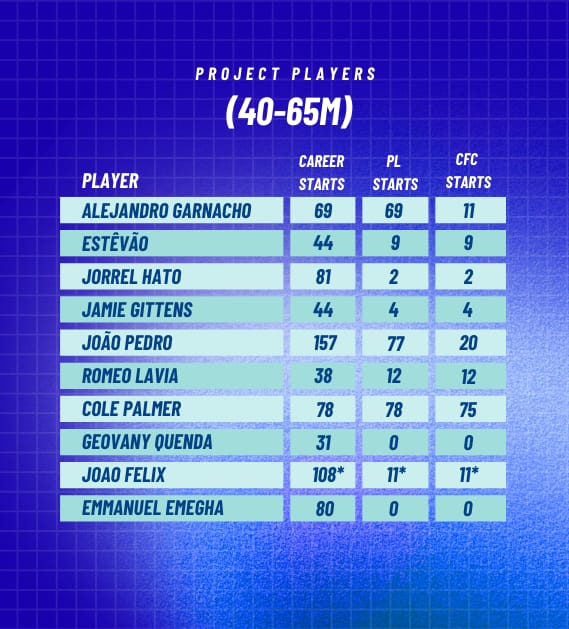
This one constitute BlueCo's portfolio of players that aren't quite there yet. They are good enough as depth for the first XI and considered capable of displacing current starters in the short-term. Estevão, Quenda, Emegha all fall into that category, which is why all 3 of them have been kept back their respective clubs to gain maximum playing time.
There are sizable risks in going in early on players. Half of BlueCo’s 10 signings in this price range had around 30 starts in their senior career before Chelsea stumped up big money. Half of them had also played 0 PL games when they were signed. Betting on a talent to reach their potential is risky enough, but to bet on them doing so while shifting to a stronger league and adapting seamlessly to hundreds of other non-footballing challenges is significantly tougher.
It is interesting to note that 8 of these 9 players still under contract at the club have yet to start more than 25 league games for the club. Half of them are yet to hit double figures. The only project player sold on this list was offloaded for a significant loss - quite logical considering not many clubs are willing to take such expensive risks. Adding a new CB like Jeremy Jacquet to the list (who will almost certainly be in this range) to a strategy that hasn’t yet proved fruitful is a risky move. Which club would want to buy dud assets off your hands at exorbitant prices when you aren’t playing them in the first place?
Plug & Play (€70m+)

These are your elite, break the bank signings - ones that will fit any system by virtue of just their quality. Enzo is a good example, having played as a B2B, DLP and a 8/10 hybrid under 4 different managers. He’s also a tough as nails bruiser who carries the armband like the Chelsea greats of yesteryear did.
Caicedo can play at DM but is also accomplished further up. Wes Fofana was considered a unicorn CB in the mould of Saliba & Van Dijk, he would probably had become one too if not for his injuries. With the outlay involved, BlueCo have been understandably reticent to go big unless they were certain of a return on their investment. Mudryk on this list is a polar bear in Arlington, Texas. But considering how badly BlueCo’s signings turned out in the first couple of windows, it is perhaps safe to assume it is unlikely to happen again.
The Verdict
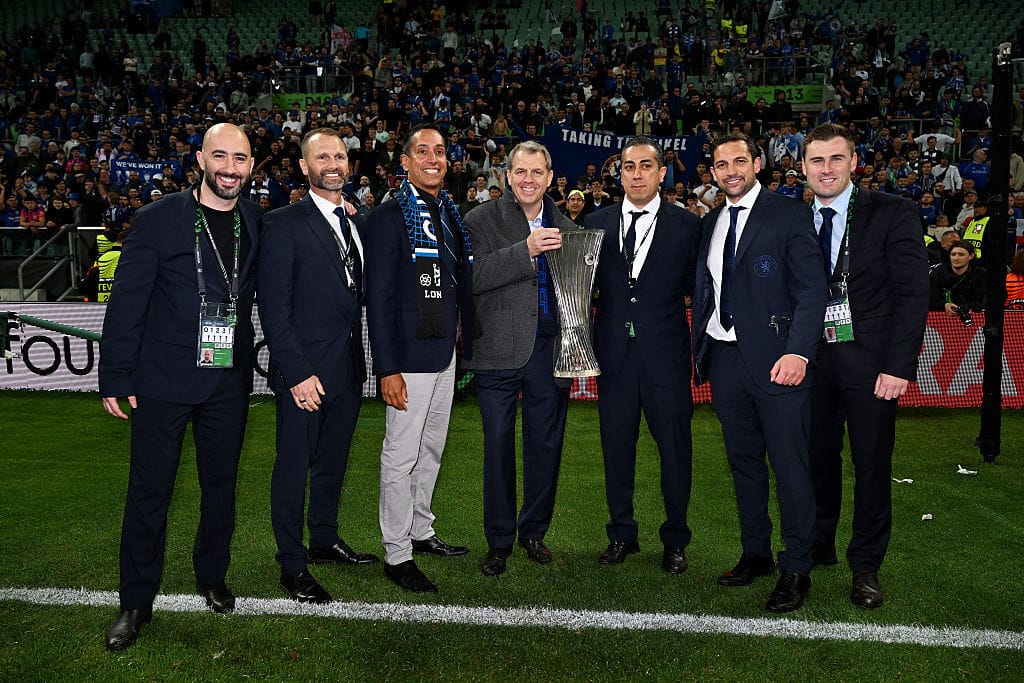
This little thought exercise only confirms what everyone knows - private equity guys know how to make money. Climbing to the summit of the transfer income charts and possessing the uncanny ability to sell combs to bald men has come in handy.
It is also quite clear that their buys in the free transfer to 35m range are better left unquestioned. Those are likely informed guesses which either yield good players, or unfortunate bets they’re still able to salvage some money on.
It’s the project players where their work leaves much to be desired. Make no mistake about it, putting stock in potential is an immensely perilous endeavour. A thousand factors - injuries, adaptation, fortune, meldonium - directly influence success and are outside the decision-maker’s grasp.
It is, however, quite damning that out of 10 players in that 40-65m range, only Cole Palmer and Estevao have emerged as undisputed hits from the get go. 3 of the 7 in the current Chelsea squad are playing their first ever PL season. Next season, two more - Quenda and Emegha - will join as PL debutants. Will they go the Palmer & Estevao way or go the Felix & Lavia route? Or will they be in the Hato & Gittens territory? That could well decide the entire outlook on how well equipped Chelsea’s hierarchy are when it comes to identifying and nurturing the needle-movers. For now there’s Estevao, Palmer & Joao Pedro to show for their hits, and there’s profit in the bank to show for their misses. That could all change next window, but for now it does buy them the time they and their signings desperately need.